
Ready to try Hearth?
Join 12,000+ families already staying in sync on one beautiful shared display.
See Pricing Learn MoreAsk any parent of school-age kids what they'd most like to reclaim, and "a calmer morning" is near the top of the list. The modern family morning is a coordination problem: multiple schedules, multiple routines, limited time, and at least one person who can't find their shoes. Smart home technology can't solve all of it — but the right setup can reliably buy back 20 to 30 minutes and dramatically lower the daily stress load.
Mornings break down in predictable ways. The first is information gaps: someone didn't know about an early practice, or forgot about picture day, or didn't realize the carpool was running late. The second is execution gaps: kids don't know what they need to do in what order, and parents end up managing each step manually instead of the household running on shared understanding. The third is coordination gaps: everyone is on different schedules and nobody has a clear view of the full picture.
Smart home tech addresses the information and execution gaps well. Coordination gaps require human habits more than technology — but having the right tools makes the habits easier to build and maintain.
The best morning routines are built the night before. Set up your family's shared calendar (via Hearth or your calendar app of choice) to send a brief summary of the next day's schedule each evening at 7 PM. This takes 30 seconds to read and eliminates 80% of the morning "wait, what's happening today?" conversations.
If you use Hearth, the display automatically shows tomorrow's schedule and each family member's calendar on the right panel from 8 PM onward — a passive visual reminder that doesn't require anyone to check anything. Kids doing their evening routine can see at a glance whether they have gym class tomorrow (so they remember to pack their kit tonight).
Set smart plugs to cut power to entertainment devices at 9 PM on school nights. This isn't punitive — it's just removing the activation energy required to end the evening. When the TV and gaming setup are simply off, the transition to bed prep becomes automatic rather than a negotiation.
A gradual smart lighting wake sequence is one of the most impactful things you can do for your own morning. Smart bulbs in the bedroom set to ramp up from 10% to 100% brightness over 20–30 minutes before your alarm, starting with warm amber light and shifting to cooler daylight-equivalent light, significantly improves how alert you feel when you actually need to get up. This is backed by sleep research and is consistently one of the highest-rated features among smart home users.
For kids, a smart light in their room (or a simple smart nightlight) set to turn on 5 minutes before you'd normally have to wake them serves as a passive signal that it's time to start getting up. Many parents report that this single change — a light that turns on at 6:55 before they'd need to call out at 7:00 — eliminates the repeated wake-up sequence entirely.
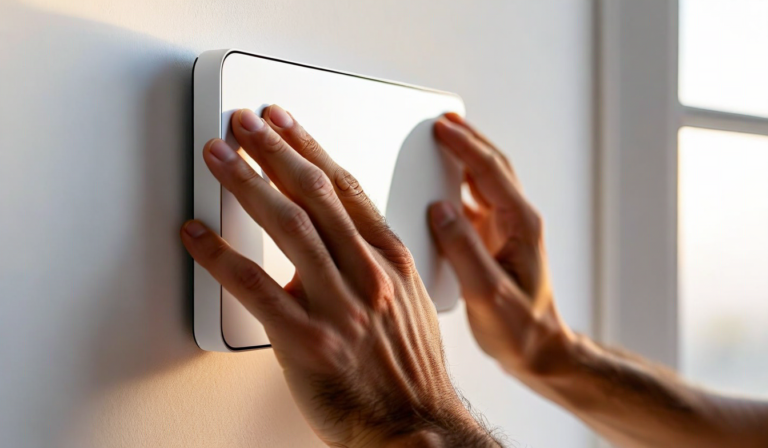
The highest-leverage thing you can put in your morning routine is a shared display that every family member can see at a glance. This is precisely what Hearth is built for. When the Hearth display is mounted in the kitchen or hallway, the morning briefing — today's schedule, each person's commitments, who has what activity, what's for breakfast, any reminders set the night before — is visible without anyone having to ask, check their phone, or be reminded.
For kids, Hearth's visual routine checklists are particularly powerful. Instead of a parent verbally managing each step ("have you brushed your teeth? do you have your lunch? where's your backpack?"), the checklist is visible on the display and kids self-manage. The routine becomes something they own, not something imposed on them. Families consistently report that this shift — from parent-managed to child-managed routines — is one of the most meaningful changes in their household dynamic.
Set your Hearth to display the morning routine checklist for each child automatically at 7 AM and transition to the full family calendar view at 7:45. This two-phase morning display reduces the cognitive load of the getting-ready window significantly.
The time savings in a well-optimized family morning don't come from one big change — they accumulate from removing small frictions. Five minutes that used to be spent figuring out what's on the schedule today. Three minutes of repeated reminders about the routine that the display now handles. Four minutes of searching for items that were prepped the night before because the schedule was visible. Two minutes of repeated wake-up attempts replaced by a light that works on the first try.
Add those up across a family of four over five school days, and you're looking at a meaningful recovery of time and a significant drop in daily stress. That's the real promise of the connected family home: not gadgets for their own sake, but a household that runs on shared information rather than repeated verbal coordination.
Build the morning routine your family deserves.
Hearth's shared display and visual routines are the foundation of a calmer, better-organized morning.
See How Hearth Works View Plans